

Hey there! As a supplier of Aluminum CPU Coolers, I've been getting a lot of questions lately about how the thickness of aluminum fins affects a CPU cooler's performance. So, I thought I'd dive deep into this topic and share my insights with you all.
Let's start by understanding the role of aluminum fins in a CPU cooler. The main job of these fins is to increase the surface area of the cooler. Why is that important? Well, the larger the surface area, the more heat can be transferred from the CPU to the surrounding air. It's like having a bigger sponge to soak up water - the bigger the sponge, the more water it can hold. In the case of a CPU cooler, the more heat it can dissipate, the better it can keep your CPU cool.
Now, when it comes to the thickness of these aluminum fins, it's not a one - size - fits - all situation. Thinner fins have their own advantages. For starters, they allow for more fins to be packed into a given space. This means that you can increase the surface area of the cooler without making it too bulky. With more fins, there are more contact points for the heat to transfer from the base of the cooler to the air.
Imagine a CPU cooler with thin fins as a crowded marketplace. There are a lot of stalls (fins) where heat can be sold (transferred) to the customers (air molecules). The more stalls, the more business (heat transfer) can be done. This can lead to better heat dissipation efficiency, especially when paired with a good fan that can move air through the fins quickly.
On the other hand, thicker fins also have their perks. Thicker fins are more rigid and can withstand higher air pressures. When you have a powerful fan pushing air through the cooler, thinner fins might bend or get damaged over time. Thicker fins are like the strong pillars of a building - they can support the force of the air flowing through them without getting deformed.
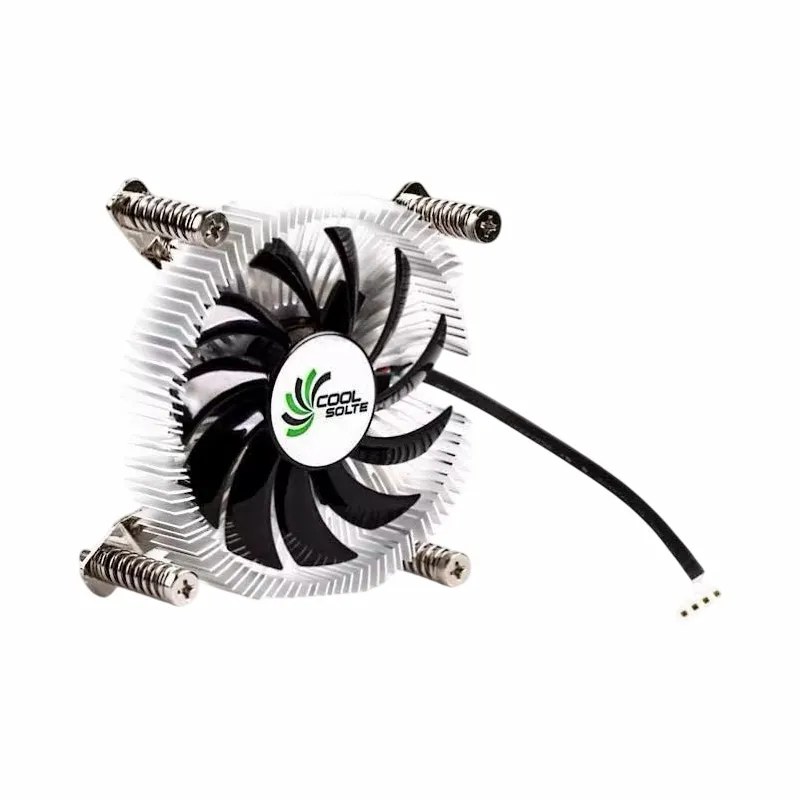

Moreover, thicker fins can hold more heat. They act as a heat reservoir. They can absorb a large amount of heat from the CPU and release it slowly over time. This can be beneficial in situations where the CPU has sudden spikes in temperature. The thicker fins can soak up the extra heat and prevent the CPU from overheating immediately.
However, there are also some drawbacks to thicker fins. Since they are thicker, you can't fit as many of them into the same space as thinner fins. This means that the overall surface area of the cooler might be lower compared to a cooler with thinner fins. So, in terms of pure surface - area - based heat transfer, thinner fins might have an edge.
Let's talk about how this all affects the real - world performance of a CPU cooler. If you're using a CPU for light tasks like web browsing, word processing, or watching videos, the difference between thin and thick fins might not be very noticeable. The CPU doesn't generate a whole lot of heat in these scenarios, so both types of coolers can do a decent job of keeping it at a reasonable temperature.
But if you're a gamer, a content creator, or someone who runs resource - intensive applications, the thickness of the fins can make a big difference. Gamers often push their CPUs to the limit, especially when playing graphically demanding games. A CPU cooler with thin fins might be more effective in this case. It can quickly transfer the large amount of heat generated by the CPU to the air, thanks to its high surface area.
Content creators who work with video editing, 3D modeling, or rendering software also need a CPU cooler that can handle high heat loads. Here, the choice between thin and thick fins depends on the specific requirements of the application. If the software causes sudden spikes in CPU usage, a cooler with thicker fins might be better at handling those spikes. If the CPU is constantly under high load, a cooler with thin fins could be the way to go.
At our company, we offer a range of Aluminum CPU Coolers with different fin thicknesses to suit various needs. We also have other great products like the Copper CPU Heatpipe Radiator for AMD Intel which combines the benefits of copper heat pipes and a radiator design for excellent heat dissipation. And don't forget our Air Cooler Fans Cooling Heat Sink for CPU that provides reliable cooling with a fan - based system. Also, check out our Computer Cooler Fan with Alloy Aluminium CPU Heat Sink which is a great all - in - one solution for your CPU cooling needs.
When choosing a CPU cooler based on fin thickness, it's important to consider your budget as well. Coolers with thinner fins might be more expensive to manufacture because they require more precise manufacturing processes to ensure that the fins are evenly spaced and don't bend easily. Thicker - fin coolers, on the other hand, might be more cost - effective, especially if you're on a tight budget.
Another factor to consider is the airflow in your computer case. If your case has poor airflow, thin fins might not be as effective. The air won't be able to move through the fins quickly enough to transfer the heat away. In this case, thicker fins might be a better option as they can hold the heat until the air can eventually carry it away.
In conclusion, the thickness of aluminum fins in a CPU cooler is a crucial factor that affects its performance. Whether you choose thin or thick fins depends on your specific needs, the type of CPU you have, the applications you run, your budget, and the airflow in your computer case.
If you're in the market for a new CPU cooler and want to learn more about how the fin thickness can work for you, or if you're interested in our Copper CPU Heatpipe Radiator for AMD Intel, Air Cooler Fans Cooling Heat Sink for CPU, or Computer Cooler Fan with Alloy Aluminium CPU Heat Sink, don't hesitate to reach out. We're here to help you make the best choice for your cooling needs. Let's start a conversation and see how we can keep your CPU running cool!
References
- "Thermal Management of Electronic Systems" - A general textbook on heat transfer in electronics
- "CPU Cooling Technologies: A Comparative Analysis" - A research paper on different CPU cooling methods and their effectiveness