

As a well - established supplier of Aluminum CPU Coolers, I've received numerous inquiries regarding the performance of our products in high - altitude environments. This topic is not only of great interest to tech enthusiasts but also to industries that operate in such challenging conditions, like aerospace, mountain - based research facilities, and high - altitude communication stations. In this blog, I'll delve into the technical aspects to determine whether our aluminum CPU coolers can effectively serve in high - altitude settings.

Understanding High - Altitude Conditions
High - altitude areas are characterized by lower air pressure and thinner air. As altitude increases, the air density decreases. For instance, at sea level, the standard atmospheric pressure is about 101.3 kPa, while at an altitude of 5000 meters, it drops to around 54 kPa. This decrease in air pressure has a significant impact on heat transfer mechanisms, which are crucial for the operation of CPU coolers.
Heat Transfer and Air Density
The primary function of a CPU cooler is to transfer heat from the CPU to the surrounding environment. There are three main modes of heat transfer: conduction, convection, and radiation. In the case of CPU coolers, conduction occurs within the cooler itself (from the CPU to the heat sink), and convection is the process by which heat is transferred from the heat sink to the air.
Convection heat transfer is highly dependent on air density. The heat transfer coefficient, which quantifies the rate of heat transfer by convection, is proportional to the air density. In high - altitude environments, the lower air density means that there are fewer air molecules available to carry away the heat from the cooler's surface. As a result, the convection heat transfer rate is reduced.
Advantages of Aluminum CPU Coolers
Thermal Conductivity
Aluminum is a popular material for CPU coolers due to its relatively high thermal conductivity. It has a thermal conductivity of about 205 W/(m·K), which allows it to quickly absorb heat from the CPU and spread it across the heat sink. This property helps in maintaining a more even temperature distribution on the heat sink surface, facilitating better heat transfer to the surrounding air.
Lightweight and Cost - Effective
Compared to other metals like copper, aluminum is lighter and more cost - effective. This makes aluminum CPU coolers easier to install and more affordable for a wide range of applications. In high - altitude environments, where weight can be a critical factor, especially in aerospace applications, the lightweight nature of aluminum coolers is a significant advantage.
Challenges for Aluminum CPU Coolers in High - Altitude Environments
Reduced Convection Efficiency
As mentioned earlier, the lower air density at high altitudes reduces the convection heat transfer efficiency. This means that the aluminum CPU cooler may not be able to dissipate heat as effectively as it does at sea level. The reduced airflow around the heat sink fins can lead to higher CPU temperatures, which may affect the performance and longevity of the CPU.
Potential for Overheating
If the CPU cooler cannot dissipate heat efficiently, the CPU may overheat. Overheating can cause the CPU to throttle its performance to prevent damage, resulting in slower processing speeds and reduced system stability. In extreme cases, it can even lead to permanent damage to the CPU.
Mitigating the Effects of High - Altitude Conditions
Enhanced Fan Design
One way to counter the reduced convection efficiency is to use fans with a higher static pressure. Static pressure is the ability of a fan to push air through a restrictive environment, such as a dense heat sink. By using fans with a higher static pressure, we can increase the airflow through the heat sink, compensating for the lower air density at high altitudes.
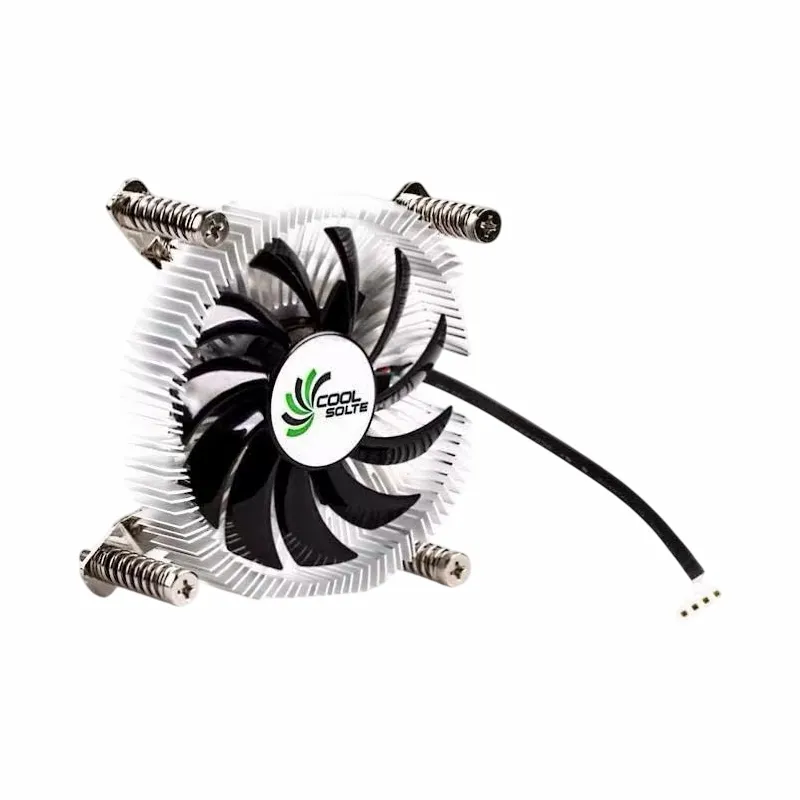
Our company offers Air Cooler Fans Cooling Heat Sink for CPU, which are designed with high - performance fans to ensure adequate airflow even in challenging environments.
Heat Pipe Technology
Another approach is to incorporate heat pipe technology into the aluminum CPU cooler. Heat pipes are highly efficient heat transfer devices that can transport heat over long distances with minimal temperature gradients. They work by using a phase - change process, where a working fluid inside the pipe evaporates at the hot end (near the CPU) and condenses at the cold end (on the heat sink fins).
We also provide Copper CPU Heatpipe Radiator for AMD Intel, which combines the high thermal conductivity of copper heat pipes with the lightweight and cost - effective nature of aluminum heat sinks. This combination helps to improve the overall heat transfer efficiency, especially in high - altitude environments.
Optimized Heat Sink Design
The design of the heat sink can also be optimized to improve its performance in high - altitude conditions. For example, using a fin design with a larger surface area can increase the contact area between the heat sink and the air, compensating for the reduced air density. Additionally, using a more open fin design can reduce the airflow resistance, allowing the fans to push air through the heat sink more easily.
Our Computer Cooler Fan with Alloy Aluminium CPU Heat Sink features an optimized fin design that maximizes the heat transfer surface area while minimizing the airflow resistance.
Conclusion
In conclusion, while high - altitude environments pose challenges for aluminum CPU coolers due to the reduced air density and convection efficiency, these challenges can be mitigated through various design and technological solutions. Our company's aluminum CPU coolers, with features such as enhanced fan design, heat pipe technology, and optimized heat sink design, are well - equipped to handle the demands of high - altitude applications.
If you are in need of high - performance CPU coolers for high - altitude environments or any other applications, we invite you to contact us for procurement and further discussions. Our team of experts is ready to provide you with the best solutions tailored to your specific requirements.
References
- Incropera, F. P., & DeWitt, D. P. (2002). Fundamentals of Heat and Mass Transfer. John Wiley & Sons.
- Holman, J. P. (2010). Heat Transfer. McGraw - Hill.
- "Engineering Thermodynamics" by Yunus A. Cengel and Michael A. Boles.