

Hey there, tech enthusiasts! As a supplier of OPS CPU heat sinks, I've been getting a ton of questions lately about whether overclocked CPUs need more powerful heat sinks. So, I thought I'd dive into this topic and share some insights with you all.
First off, let's quickly cover what overclocking is. Overclocking is the process of making your CPU run at a higher clock speed than its factory - set default. When you overclock a CPU, you're essentially pushing it to work harder and faster. This means it's processing more instructions per second, which is great for getting better performance in things like gaming, video editing, and other CPU - intensive tasks.
But here's the catch: when a CPU works harder, it generates more heat. Heat is the enemy of any electronic component, especially CPUs. High temperatures can lead to a bunch of problems, like reduced performance due to thermal throttling (where the CPU slows itself down to avoid overheating), and in extreme cases, it can even damage the CPU permanently.
So, do overclocked CPUs need more powerful heat sinks? The short answer is yes, and here's why.
The Science Behind Heat Generation in Overclocked CPUs
CPUs generate heat through the electrical resistance in their circuits. When you overclock a CPU, you increase the voltage and the clock speed. The higher voltage means more electrical current is flowing through the CPU, and with more current comes more resistance and, therefore, more heat.
Think of it like a car engine. If you floor the accelerator and make the engine work at its maximum capacity, it's going to get hotter than when it's idling or cruising at a normal speed. Similarly, an overclocked CPU is like a car engine running at full throttle all the time.
A standard heat sink that comes with a CPU is designed to handle the heat generated at the factory - set clock speed. When you overclock, the heat output can increase significantly, and the stock heat sink may not be able to dissipate that extra heat effectively.
How a More Powerful Heat Sink Helps
A more powerful heat sink is designed to dissipate heat more efficiently. There are a few key features that make a heat sink more powerful:
Larger Surface Area
The surface area of a heat sink is crucial for heat dissipation. The more surface area there is, the more heat can be transferred from the CPU to the surrounding air. A powerful heat sink usually has a larger fin array, which provides more area for heat transfer.
Better Materials
Heat sinks can be made from different materials, such as aluminum and copper. Copper is a better conductor of heat than aluminum, so heat sinks made from copper can transfer heat away from the CPU more quickly. For example, our Copper CPU Heatpipe Radiator for AMD Intel uses high - quality copper to ensure excellent heat conductivity.
Heatpipes
Heatpipes are another important feature in powerful heat sinks. They work like a super - efficient heat transfer system. Inside a heatpipe, there's a small amount of liquid that evaporates when it absorbs heat from the CPU. The vapor then travels to the cooler part of the heatpipe, where it condenses back into a liquid and releases the heat. This cycle repeats, allowing heat to be transferred quickly from the CPU to the fins of the heat sink.
More Powerful Fans
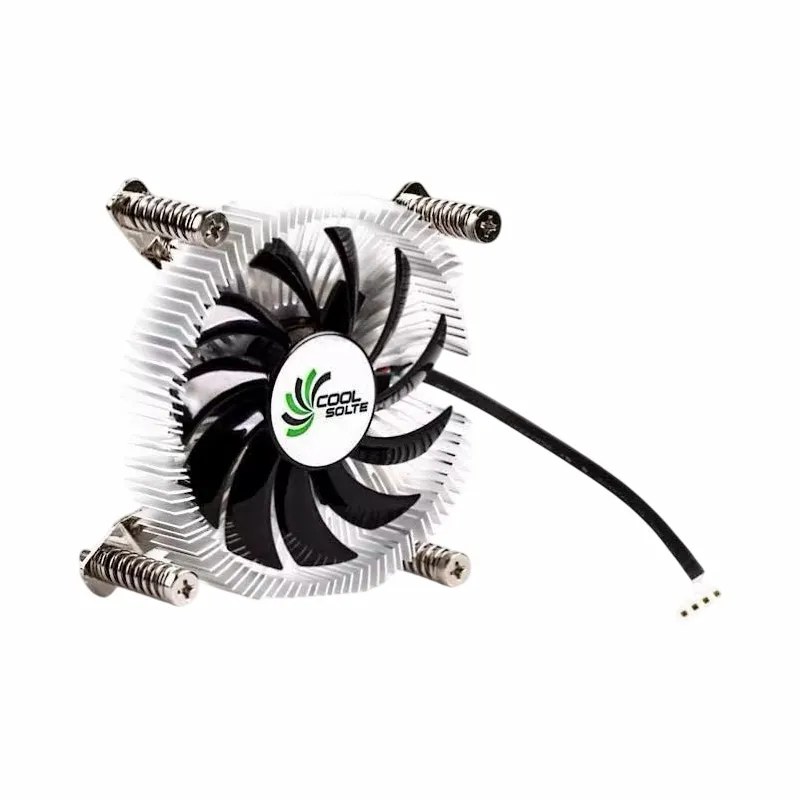
A good heat sink often comes with a powerful fan or multiple fans. The fans help to move the hot air away from the heat sink and bring in cooler air. Our Computer Cooler Fan with Alloy Aluminium CPU Heat Sink has a high - performance fan that can provide strong airflow, ensuring effective heat dissipation.
Real - World Examples
Let's take a look at some real - world scenarios. Say you have a CPU that's running at its stock clock speed of 3.0 GHz, and it's generating around 60 watts of heat. A stock heat sink can usually handle this amount of heat just fine, and the CPU temperature stays within a safe range.
Now, if you overclock that CPU to 4.0 GHz, the heat output might increase to 100 watts or more. The stock heat sink will struggle to keep up, and the CPU temperature will start to rise. You might notice your system becoming less responsive, or you could even experience crashes.
On the other hand, if you install a more powerful heat sink, like our Air Cooler Fans Cooling Heat Sink for CPU, it can handle the increased heat output. The CPU will stay at a lower temperature, and you'll be able to enjoy the benefits of overclocking without any performance issues.

Factors to Consider When Choosing a Heat Sink for an Overclocked CPU
When you're looking for a heat sink for an overclocked CPU, there are a few things you need to keep in mind:
Compatibility
Make sure the heat sink is compatible with your CPU socket type. Different CPUs have different socket designs, and you need a heat sink that will fit properly.
Size
Consider the size of the heat sink. Some high - performance heat sinks can be quite large, and they might not fit in your computer case. You need to make sure there's enough space for the heat sink and that it won't interfere with other components.
Noise Level
Powerful fans can be noisy. If you're sensitive to noise, look for a heat sink that has a good balance between performance and noise. Some heat sinks come with features like fan speed control, which can help reduce noise when the CPU isn't under heavy load.
Conclusion
In conclusion, if you're planning to overclock your CPU, investing in a more powerful heat sink is a must. It's the best way to ensure that your CPU stays cool and performs at its best. At our company, we offer a wide range of high - quality OPS CPU heat sinks that are designed to handle the heat generated by overclocked CPUs.
If you're interested in learning more about our products or have any questions about choosing the right heat sink for your overclocked CPU, don't hesitate to reach out. We're here to help you make the best decision for your system. Whether you're a casual gamer looking for a bit more performance or a professional in need of high - end computing power, we've got the heat sink solutions for you. Let's start a conversation and see how we can meet your cooling needs!
References
- "Thermal Management of Electronic Systems" by Ravi S. Prasher
- "Microelectronics Cooling Technology Handbook" by Avram Bar - Cohen