

Hey there, fellow tech enthusiasts! I'm here today to chat about something that's been on my mind a lot lately: Are low profile AIO coolers suitable for overclocking in a budget - friendly way? As a supplier of low profile AIO coolers, I've got some insights to share with you.
First off, let's talk about what overclocking is. For those who aren't in the know, overclocking is when you push your CPU beyond its factory - set limits to get more performance out of it. It's like squeezing every last drop of juice from your CPU to make your computer run faster and handle more demanding tasks. But here's the catch: when you overclock, your CPU generates a whole lot more heat. And that's where a good cooler comes in.
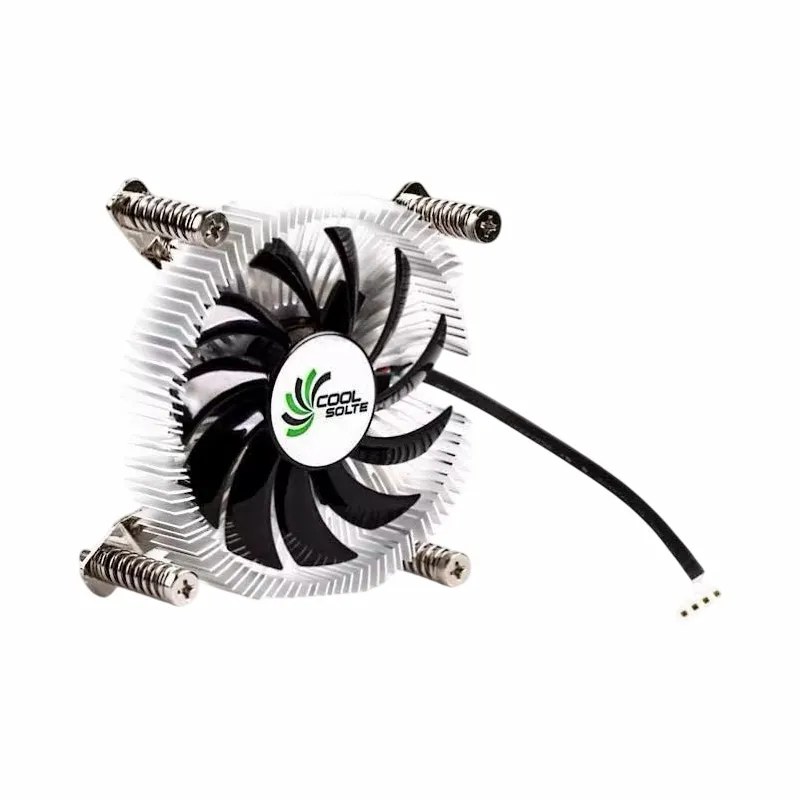

Now, there are different types of coolers out there. You've got air coolers and all - in - one (AIO) liquid coolers. Air coolers are the traditional option. They're usually cheaper and pretty reliable. You can check out this Computer Cooler Fan with Alloy Aluminium CPU Heat Sink as an example. It's a solid choice for normal use, but when it comes to overclocking, they might struggle a bit. They rely on air to dissipate heat, and sometimes, they just can't keep up with the extra heat generated by an overclocked CPU.
On the other hand, AIO liquid coolers are more efficient at cooling. They use a liquid coolant to transfer heat away from the CPU to a radiator, where it's then dissipated into the air. They're generally better at handling the heat of an overclocked CPU. But the full - sized AIO coolers can be pretty expensive and take up a lot of space in your PC case.
This is where low profile AIO coolers come in. They're a bit of a sweet spot. They offer the cooling efficiency of a liquid cooler but in a more compact and budget - friendly package. They're designed to fit in smaller PC cases, which is great if you've got a mini - ITX or small form factor build.
Let's talk about the budget - friendly aspect. When you're on a tight budget, you don't want to break the bank on a cooler. Low profile AIO coolers are often more affordable than their full - sized counterparts. You can get a decent low profile AIO cooler for a fraction of the cost of a high - end, full - sized AIO. And considering the performance they offer, it's a pretty good deal.
But are they suitable for overclocking? Well, it depends. If you're doing light overclocking, like just bumping up the clock speed a little bit, a low profile AIO cooler should be able to handle it just fine. They can keep your CPU temperatures in check and prevent it from throttling.
However, if you're going for extreme overclocking, pushing your CPU to its absolute limits, a low profile AIO might struggle. Extreme overclocking generates a ton of heat, and even though low profile AIO coolers are efficient, they might not have the same cooling capacity as a full - sized AIO.
Another thing to consider is the build quality. Not all low profile AIO coolers are created equal. Some might have better pumps, better radiators, or better fans than others. You want to make sure you're getting a quality product. For example, this Air Cooler Fans Cooling Heat Sink for CPU gives you an idea of the importance of good components in a cooler.
In terms of installation, low profile AIO coolers are usually pretty easy to install. They're designed to be user - friendly, which is great if you're not an experienced PC builder. You don't have to deal with complex tubing or a huge radiator that's hard to fit into your case.
Now, let's talk about the compatibility. Low profile AIO coolers are generally more compatible with a wider range of PC cases. Since they're smaller, they can fit into cases that a full - sized AIO wouldn't be able to. But you still need to make sure it's compatible with your CPU socket. Most low profile AIO coolers support common CPU sockets like Intel LGA115x and AMD AM4, but it's always a good idea to double - check.
One of the benefits of using a low profile AIO cooler for overclocking is the noise level. They tend to be quieter than air coolers, especially when under load. Air coolers often have to spin their fans at high speeds to keep the CPU cool, which can create a lot of noise. Low profile AIO coolers can achieve the same cooling performance with less noise, which is great if you want a quiet PC.
If you're looking for a more high - end option for overclocking, you might consider a Copper CPU Heatpipe Radiator for AMD Intel. Copper is a great conductor of heat, and a heatpipe radiator can provide excellent cooling performance. But again, these can be more expensive.
In conclusion, low profile AIO coolers can be a great option for budget - friendly overclocking, especially if you're doing light to moderate overclocking. They offer a good balance between cooling performance, cost, and space. They're easy to install, compatible with many PC cases, and generally quieter than air coolers.
If you're interested in learning more about our low profile AIO coolers or are thinking about making a purchase, I'd love to chat with you. Whether you're a casual PC user looking to get a bit more performance out of your system or a serious overclocker on a budget, we've got a solution for you. Just reach out, and we can start a conversation about your specific needs.
References:
- General knowledge of PC hardware components and cooling technologies.
- Industry reviews and comparisons of different types of CPU coolers.