

Hey there! I'm a supplier for a heat sink company, and let me tell you, the world of heat sinks is evolving faster than ever. There are some seriously cool emerging technologies that we can adopt to stay ahead of the game. In this blog, I'll break down these technologies and explain why they're a big deal for our business.
Phase - Change Materials (PCMs)
One of the most exciting emerging technologies for heat sinks is the use of phase - change materials. PCMs are substances that can absorb and release large amounts of energy during the process of changing from one phase to another, usually from solid to liquid and vice versa.
When a heat sink uses PCMs, it can store a significant amount of heat energy as the PCM melts. This helps to keep the temperature of the device being cooled more stable. For example, in a high - performance CPU, the heat generated during intense processing can be absorbed by the PCM in the heat sink. As the PCM solidifies again when the CPU's workload decreases, it releases the stored heat.
This technology is a game - changer because it offers a more efficient way to manage heat spikes. It's like having a buffer that can soak up extra heat and release it gradually. Using PCMs in our heat sinks could make them more effective in handling the increasing power densities of modern electronic devices. You can check out our Black Anodized Aluminum Heat Sink for CPU which could potentially be enhanced with PCM technology in the future.
Graphene - Based Heat Sinks
Graphene is another super - material that's making waves in the heat sink industry. It's a single layer of carbon atoms arranged in a hexagonal lattice, and it has some amazing thermal properties. Graphene has extremely high thermal conductivity, which means it can transfer heat very quickly.
Compared to traditional materials like aluminum, graphene can conduct heat much more efficiently. This allows for faster dissipation of heat from the source, such as a CPU or GPU. When we integrate graphene into our heat sinks, we can create a more effective cooling solution.
For instance, a heat sink with a graphene layer can draw heat away from the device and spread it across a larger surface area in a shorter time. This helps to keep the device cooler and can potentially improve its performance and lifespan. Our Mini Computer Heat Sink for CPU Devices could benefit greatly from the addition of graphene technology.
Micro - Channel Heat Sinks
Micro - channel heat sinks are also on the rise. These heat sinks have tiny channels that are used to circulate a coolant, usually a liquid. The small size of the channels increases the surface area available for heat transfer between the coolant and the heat sink.
When a liquid coolant flows through these micro - channels, it absorbs heat from the heat sink and carries it away. This is a very efficient way to cool high - power devices. Micro - channel heat sinks can be designed to fit into small spaces, making them ideal for compact electronic devices like laptops and tablets.
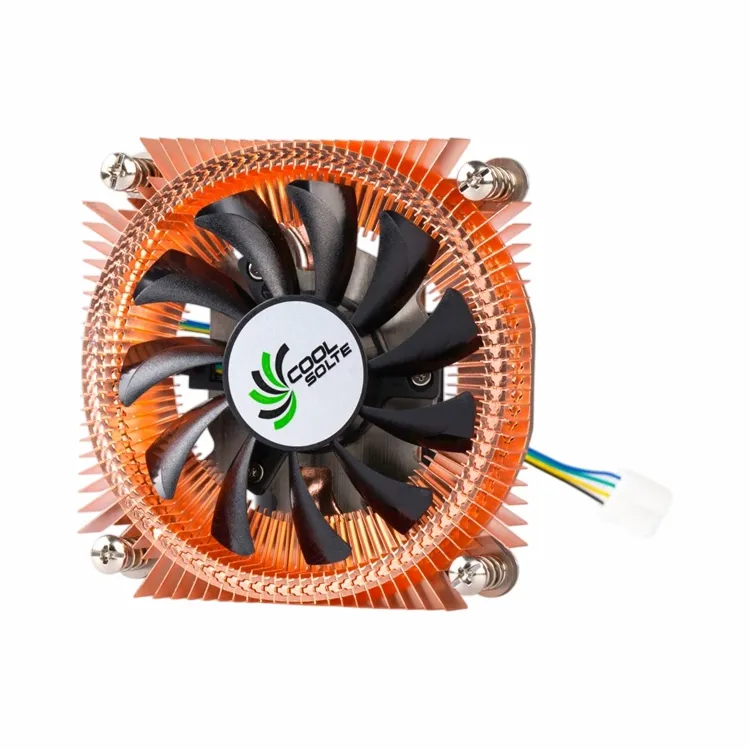
The advantage of micro - channel heat sinks is that they can provide a high level of cooling performance in a small form factor. They can also be customized to meet the specific cooling requirements of different devices. If you're looking for a high - performance cooling solution, our CPU Cooling Fan with Heatsink could potentially be combined with micro - channel technology for even better results.
Active Cooling with Smart Sensors
Active cooling systems are getting smarter with the integration of sensors. These sensors can monitor the temperature of the device being cooled in real - time. Based on the temperature readings, the cooling system can adjust its operation.
For example, if the sensor detects that the CPU temperature is rising rapidly, it can increase the speed of the cooling fan or activate additional cooling mechanisms. This ensures that the device is always kept at an optimal temperature. Smart sensors also help to save energy because the cooling system only operates at full capacity when it's really needed.
By adopting this technology in our heat sinks, we can offer more intelligent and energy - efficient cooling solutions. It's a win - win situation for both the end - users and the environment.
Nanofluids
Nanofluids are another emerging technology that has great potential for heat sinks. These are fluids that contain nanoparticles, such as metals or metal oxides. The addition of nanoparticles to a base fluid can significantly enhance its thermal conductivity.
When used in a heat sink, nanofluids can transfer heat more effectively than traditional coolants. The nanoparticles increase the surface area available for heat transfer and also improve the fluid's ability to carry heat. This means that a heat sink using nanofluids can cool a device more efficiently.
Nanofluids can be used in conjunction with other cooling technologies, like micro - channel heat sinks. They offer a promising way to improve the overall performance of our heat sinks and meet the growing demand for better cooling in high - power electronics.
Why These Technologies Matter for Our Business
As a heat sink company, adopting these emerging technologies is crucial for several reasons. Firstly, the demand for more powerful and compact electronic devices is increasing. These devices generate more heat, and traditional heat sink technologies may not be sufficient to keep them cool. By using these new technologies, we can create heat sinks that can handle the higher heat loads.
Secondly, it gives us a competitive edge in the market. Customers are always looking for the latest and greatest in cooling technology. If we can offer heat sinks with advanced features like PCMs, graphene, or smart sensors, we'll be more likely to attract new customers and retain existing ones.
Finally, it's about future - proofing our business. As technology continues to evolve, so will the requirements for heat management. By staying at the forefront of these emerging technologies, we can ensure that our heat sinks remain relevant and in demand for years to come.

Let's Connect
If you're interested in learning more about these emerging technologies and how they can be incorporated into our heat sinks, I'd love to talk to you. Whether you're a manufacturer looking for high - performance cooling solutions or a distributor wanting to offer the latest products to your customers, we can have a great discussion. Reach out to us to start a conversation about how we can work together to meet your heat sink needs.
References
- "Thermal Management of Electronic Devices and Systems", by Avram Bar - Cohen and Ali Boroushaki
- "Nanofluids: Properties, Preparation and Applications", by Rajender B. Garg and Suresh K. Bhargava
- "Graphene: Synthesis, Properties, and Phenomena", by Alexander A. Balandin