

As a supplier of mini PC CPU heat sinks, I've witnessed firsthand the pivotal role that heat sink design plays in the overall performance of a mini PC. In this blog, I'll delve into how the shape of a mini PC CPU heat sink affects its performance, drawing on both industry knowledge and practical experience.
Basic Principles of Heat Dissipation
Before we discuss the impact of shape, it's essential to understand the basic principles of heat dissipation. Heat transfer from the CPU to the heat sink occurs mainly through conduction, and then from the heat sink to the surrounding air via convection and radiation. The efficiency of these processes determines how effectively the heat sink can keep the CPU cool.
Impact of Different Shapes on Heat Dissipation
Pin - Type Heat Sinks
Pin - type heat sinks are characterized by an array of pins protruding from a base. These pins significantly increase the surface area available for heat transfer. A larger surface area allows for more contact between the heat sink and the surrounding air, facilitating greater convection.
The pins on a pin - type heat sink can be arranged in various densities. A higher pin density generally means more surface area, but it can also impede air flow. If the air cannot flow freely through the pins, the efficiency of convection is reduced. For example, in a high - density pin - type heat sink, the air may become stagnant between the pins, forming a boundary layer that acts as an insulator and reduces heat transfer.
On the other hand, a lower pin density allows for better air flow but may sacrifice some surface area. Therefore, finding the right balance is crucial. Our CPU Cooling Fan with Heatsink sometimes incorporates pin - type designs, and we carefully optimize the pin density to ensure both sufficient surface area and good air flow.
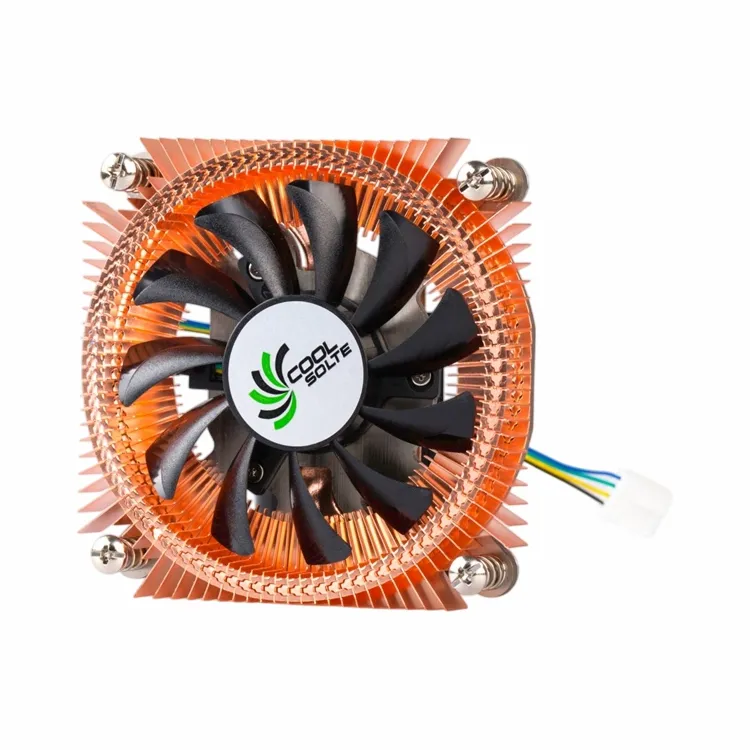

Fin - Type Heat Sinks
Fin - type heat sinks are perhaps the most common shape in the market. They consist of a series of thin fins attached to a base. Similar to pin - type heat sinks, fins increase the surface area for heat transfer.
The shape and arrangement of the fins have a significant impact on performance. Straight fins are the simplest design. They offer a relatively unobstructed path for air flow, which is beneficial for convection. However, they may not be as effective in maximizing surface area compared to more complex fin designs.
Some fin - type heat sinks feature curved or angled fins. These designs can enhance air flow by guiding the air in a specific direction, reducing turbulence and improving the efficiency of convection. For instance, our CPU Heat Sink with Fin for Thermoelectric Cooling uses a combination of curved and straight fins to optimize both surface area and air flow.
Another factor to consider is the fin thickness. Thicker fins can conduct heat more effectively from the base to the tip, but they also reduce the number of fins that can be placed in a given space. Thinner fins, on the other hand, increase the surface area but may have lower thermal conductivity.
Heat Pipes and Their Impact on Shape
Heat pipes are often integrated into heat sink designs to enhance heat transfer. A heat pipe is a sealed tube filled with a working fluid. When one end of the heat pipe is heated (usually in contact with the CPU), the working fluid evaporates and carries the heat to the other end of the pipe. There, the fluid condenses and releases the heat.
The shape of the heat sink can be designed to work in harmony with the heat pipes. For example, in some heat sink designs, the heat pipes are bent and routed through the fins to ensure maximum heat transfer. This allows the heat to be spread more evenly across the heat sink, improving overall performance.
Impact on Air Flow and Noise
The shape of the heat sink also affects air flow and noise levels. A heat sink with a complex shape that restricts air flow may require a more powerful fan to maintain adequate cooling. However, a more powerful fan usually generates more noise.
For example, a heat sink with a very dense pin or fin arrangement may cause the fan to work harder to push air through. This not only increases noise but also consumes more power. On the other hand, a well - designed heat sink with a shape that promotes smooth air flow can reduce the load on the fan, resulting in quieter operation and lower power consumption.
Our Black Anodized Aluminum Heat Sink for CPU is designed with air flow in mind. The anodized aluminum surface not only provides good corrosion resistance but also helps in radiation heat transfer. The shape of the heat sink allows for efficient air flow, reducing the need for a high - speed, noisy fan.
Impact on Space and Compatibility
In the world of mini PCs, space is a precious commodity. The shape of the heat sink must be carefully considered to ensure compatibility with the limited space inside the mini PC case.
A large, bulky heat sink may not fit into a small - form - factor mini PC. Therefore, heat sink manufacturers often need to come up with innovative shapes that can provide effective cooling in a compact space. For example, some heat sinks are designed to be low - profile, with fins that are arranged in a way that minimizes the overall height of the heat sink.
Conclusion
In conclusion, the shape of a mini PC CPU heat sink has a profound impact on its performance. From heat dissipation efficiency to air flow, noise levels, and space compatibility, every aspect of the shape matters. As a supplier of mini PC CPU heat sinks, we are constantly researching and developing new shapes and designs to meet the ever - evolving needs of the market.
If you are in the market for high - quality mini PC CPU heat sinks, we invite you to contact us for a detailed discussion. We can provide customized solutions based on your specific requirements, ensuring optimal performance for your mini PCs.
References
- Incropera, F. P., & DeWitt, D. P. (2002). Fundamentals of Heat and Mass Transfer. Wiley.
- Cengel, Y. A. (2003). Heat Transfer: A Practical Approach. McGraw - Hill.