

How does the number of fins on a copper heat sink affect its performance?
As a seasoned supplier of copper heat sinks, I've witnessed firsthand the critical role these components play in various electronic devices. One of the most frequently debated topics in the heat sink industry is how the number of fins on a copper heat sink impacts its performance. In this blog post, I'll delve into the science behind it, share real - world insights, and provide practical advice for making the right choice.
The Basics of Heat Transfer in Copper Heat Sinks
Before we discuss the impact of fin number, it's essential to understand how copper heat sinks work. Heat transfer in a heat sink primarily occurs through three mechanisms: conduction, convection, and radiation. Copper is an excellent conductor of heat, which means it can quickly absorb heat from the heat source (such as a CPU) and transfer it to the fins.
Conduction is the transfer of heat through a solid material. In a copper heat sink, heat moves from the base, which is in direct contact with the heat source, to the fins. Convection, on the other hand, is the transfer of heat between the fins and the surrounding air. As the air flows over the fins, it absorbs the heat and carries it away. Radiation is the emission of heat in the form of electromagnetic waves, but in most heat sink applications, convection is the dominant heat - transfer mechanism.

The Role of Fins in Heat Dissipation
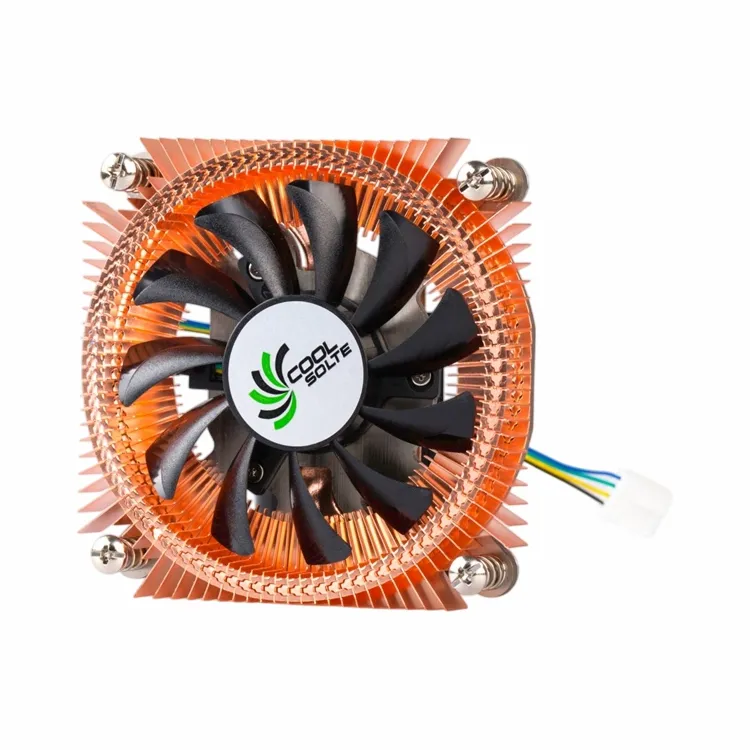
Fins are an integral part of a copper heat sink as they significantly increase the surface area available for heat transfer. The larger the surface area, the more heat can be dissipated into the surrounding air. When the heat from the base of the heat sink reaches the fins, it spreads out over a larger area, making it easier for the air to carry the heat away.
Impact of Fin Number on Heat Sink Performance
1. Surface Area and Heat Dissipation
The most obvious effect of increasing the number of fins is an increase in the total surface area of the heat sink. As the surface area grows, more heat can be transferred from the fins to the air. For example, if we compare a heat sink with 10 fins to one with 20 fins of the same size and material, the heat sink with 20 fins will have a larger surface area and, in theory, should be able to dissipate more heat.
However, there's a limit to how much the surface area can be increased by adding more fins. As the fins become more closely spaced, the air may have difficulty flowing between them. This can lead to a phenomenon called "air blockage," where the air velocity between the fins decreases, reducing the convective heat - transfer coefficient.
2. Airflow Resistance
Another important factor to consider is the airflow resistance. When the number of fins is increased, the space between the fins becomes smaller. This can create more resistance to the airflow, making it harder for the air to pass through the heat sink. As a result, the air velocity may decrease, and the convective heat - transfer rate may be negatively affected.
In applications where a high - speed fan is used to force air through the heat sink, the impact of increased airflow resistance may be less significant. However, in passive cooling systems, where the air moves naturally over the heat sink, the airflow resistance can have a substantial impact on the heat sink's performance.
3. Manufacturing Constraints
Increasing the number of fins also presents manufacturing challenges. As the fins become thinner and more closely spaced, it becomes more difficult to manufacture them with high precision. This can lead to variations in fin thickness and spacing, which can affect the heat sink's performance. Additionally, more fins may require more material, increasing the cost of the heat sink.
Real - World Examples and Considerations
Let's take a look at some real - world products to illustrate the impact of fin number on heat sink performance.
Our Mini Computer Heat Sink for CPU Devices is designed with a specific number of fins to balance surface area and airflow resistance. In a mini - computer environment, space is limited, and the airflow may not be as strong as in a larger computer case. Therefore, the number of fins is carefully chosen to ensure efficient heat dissipation without creating excessive airflow resistance.
The Black Anodized Aluminum Heat Sink for CPU also takes into account the fin number. Aluminum has different thermal properties compared to copper, but the principle of balancing surface area and airflow remains the same. The anodized finish on this heat sink not only provides corrosion resistance but also affects the heat - transfer characteristics.
For more demanding applications, our CPU Cooling Fan with Heatsink combines a heat sink with a fan to enhance the airflow. The number of fins on the heat sink is optimized to work in conjunction with the fan, ensuring maximum heat dissipation.
Choosing the Right Number of Fins
When choosing a copper heat sink, it's important to consider the specific application requirements. Here are some factors to keep in mind:
- Heat Load: The amount of heat generated by the heat source is a crucial factor. If the heat load is high, a heat sink with a larger surface area (more fins) may be required. However, make sure to also consider the airflow requirements.
- Airflow: The type of airflow (forced or natural) and the available airflow rate should be taken into account. If the airflow is limited, a heat sink with fewer fins may be more suitable to reduce airflow resistance.
- Space Constraints: In applications where space is limited, the size and number of fins may need to be adjusted accordingly. A heat sink with too many fins may not fit in the available space, or it may block other components.
Conclusion
In conclusion, the number of fins on a copper heat sink has a significant impact on its performance. While increasing the number of fins can increase the surface area and potentially improve heat dissipation, it can also increase airflow resistance and present manufacturing challenges. The key is to find the right balance based on the specific application requirements.
If you're in the market for a high - quality copper heat sink and need help choosing the right product for your application, I encourage you to reach out to us for a detailed discussion. Our team of experts is ready to assist you in finding the perfect heat sink solution for your needs.

References
- Incropera, F. P., DeWitt, D. P., Bergman, T. L., & Lavine, A. S. (2007). Fundamentals of Heat and Mass Transfer. Wiley.
- Cengel, Y. A. (2003). Heat Transfer: A Practical Approach. McGraw - Hill.