

As a supplier of mini PC CPU heat sinks, I've witnessed firsthand the critical role that heat sink design plays in effective cooling. In the world of mini PCs, where space is at a premium and components are densely packed, the ability to dissipate heat efficiently can make or break the performance and longevity of the system. In this blog post, I'll delve into the various aspects of heat sink design and how they impact cooling performance.
Material Selection
The choice of material for a mini PC CPU heat sink is fundamental to its cooling capabilities. The most common materials used are aluminum and copper, each with its own set of properties.
Aluminum is a popular choice due to its lightweight nature and relatively low cost. It has a good thermal conductivity, which allows it to transfer heat away from the CPU effectively. Our Black Anodized Aluminum Heat Sink for CPU is made from high - quality aluminum that has been anodized to improve its durability and corrosion resistance. Anodization also gives the heat sink a sleek black finish, which is aesthetically pleasing for mini PC builds.
Copper, on the other hand, has a much higher thermal conductivity than aluminum. This means it can absorb and transfer heat more quickly. However, copper is heavier and more expensive than aluminum. In some high - performance mini PC heat sinks, a combination of copper and aluminum is used. The base of the heat sink may be made of copper to quickly absorb heat from the CPU, while the fins are made of aluminum to keep the weight down and reduce cost.
Fin Design
The fins of a heat sink are crucial for increasing the surface area available for heat dissipation. A larger surface area allows more heat to be transferred from the heat sink to the surrounding air.
There are several types of fin designs. Straight fins are the simplest and most common. They are easy to manufacture and provide a relatively large surface area. However, they may not be the most efficient in terms of air flow. Our CPU Heat Sink with Fin for Thermoelectric Cooling features a well - designed straight fin structure that maximizes the surface area while still allowing for decent air flow.
Pin fins are another type of fin design. These are small, cylindrical pins that protrude from the base of the heat sink. Pin fins can provide a very large surface area in a small space, making them ideal for mini PCs. They also allow for better air flow in multiple directions, which can improve cooling efficiency.
Wave - shaped fins are a more advanced design. They can disrupt the air flow in a way that increases the turbulence, which in turn enhances heat transfer. This type of fin design is often used in high - end mini PC heat sinks where space is limited but maximum cooling performance is required.
Heat Pipe Integration
Heat pipes are a key technology in modern mini PC CPU heat sinks. A heat pipe is a sealed tube that contains a small amount of liquid, usually water or a refrigerant. When one end of the heat pipe is heated (in contact with the CPU), the liquid inside evaporates. The vapor then travels to the cooler end of the heat pipe, where it condenses and releases the heat. The condensed liquid then returns to the hot end through capillary action.
Heat pipes are extremely efficient at transferring heat over long distances with very little temperature drop. In a mini PC heat sink, heat pipes can be used to transfer heat from the CPU to the fins, even if the fins are located some distance away from the CPU. This allows for more flexible heat sink designs, especially in cases where space is restricted.
Fan Design and Placement
A fan is often used in conjunction with a heat sink to improve cooling performance. The fan blows air over the fins of the heat sink, which helps to carry away the heat.
The size and speed of the fan are important factors. A larger fan can move more air at a lower speed, which is generally quieter. However, in a mini PC, space may limit the size of the fan that can be used. Our CPU Cooling Fan with Heatsink is designed to be compact yet powerful, providing sufficient air flow to cool the CPU effectively.

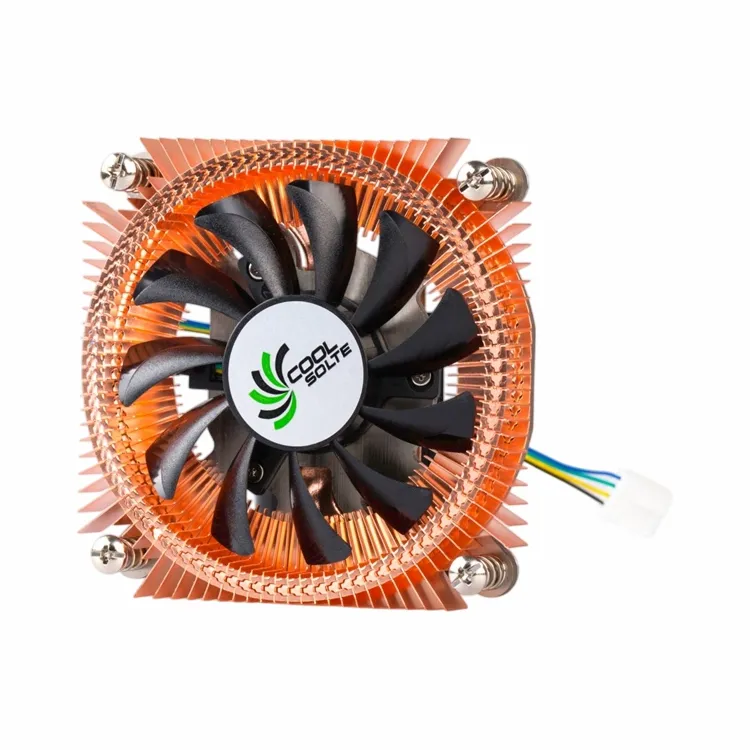
The placement of the fan also matters. It should be positioned in such a way that it blows air directly over the fins of the heat sink. Some heat sinks have a fan mounted on top, while others have it mounted on the side. The optimal placement depends on the overall design of the mini PC and the heat sink.
Contact Surface and Thermal Interface Material
The contact surface between the heat sink and the CPU is critical for efficient heat transfer. The surface should be as flat and smooth as possible to ensure maximum contact area. Any gaps or unevenness can reduce the heat transfer efficiency.
A thermal interface material (TIM) is used to fill in the microscopic gaps between the heat sink and the CPU. TIMs are usually made of materials such as thermal paste or thermal pads. Thermal paste is a viscous substance that can conform to the surface irregularities, while thermal pads are pre - cut sheets that are easier to apply. A high - quality TIM can significantly improve the heat transfer between the CPU and the heat sink.
Impact on Cooling Performance
All of these design factors work together to determine the cooling performance of a mini PC CPU heat sink. A well - designed heat sink can keep the CPU at a lower temperature, which in turn can improve the performance and stability of the mini PC.
Lower temperatures can prevent the CPU from throttling, which is a process where the CPU reduces its clock speed to avoid overheating. Throttling can significantly reduce the performance of the system, especially during intensive tasks such as gaming or video editing.
In addition, a cooler CPU has a longer lifespan. High temperatures can cause the CPU to degrade over time, leading to premature failure. By using a high - quality heat sink with an optimized design, the lifespan of the CPU can be extended.
Conclusion
The design of a mini PC CPU heat sink has a profound impact on cooling performance. From material selection to fin design, heat pipe integration, fan design and placement, and the use of thermal interface materials, every aspect of the design plays a crucial role.
As a supplier of mini PC CPU heat sinks, we are constantly researching and developing new designs to improve cooling efficiency. Our products, such as the CPU Cooling Fan with Heatsink, Black Anodized Aluminum Heat Sink for CPU, and CPU Heat Sink with Fin for Thermoelectric Cooling, are designed with the latest technologies and best practices in mind.
If you are in the market for high - quality mini PC CPU heat sinks, we invite you to contact us for procurement and to discuss your specific requirements. We are committed to providing the best products and services to meet your cooling needs.
References
- Incropera, F. P., & DeWitt, D. P. (2002). Fundamentals of Heat and Mass Transfer. John Wiley & Sons.
- Çengel, Y. A., & Ghajar, A. J. (2015). Heat and Mass Transfer: Fundamentals and Applications. McGraw - Hill Education.